Wednesday, 22 May 2019

Euro Oyc on 20 May 2019. # 4 for Newfoundland. Photo Salon

 It is a good day when you get a late evening email reporting an oystercatcher in Newfoundland.  Automatically one thinks Eurasian Oystercatcher, especially in spring when the natural winds are generating an air flow from Iceland.  It was Bruce Bradbury who can be thanked for exposing this record to the world. His sister in law Marilyn Gillingham at Lushes Bight, Long Island on the northeast coast of Newfoundland saw the strange bird and had Bruce B to report it to. According to her Birds of North American book it was an American Oystercatcher. BUT that is the expected ID path when using a North American book.  American Oystercatcher has not been recorded in Newfoundland but there are three previous records for the look-a-like Eurasian Oystercatcher.

I hummed and hawed at the ordeal of the long drive to Lushes Bight for a bird I had already seen twice in Newfoundland and had just seen them by the hundreds in Ireland in  February 2019.  With the Victoria Weekend on our doorstep there was lots of free time available.  I was torn. I wanted to explore the southern Avalon Peninsula for additional vagrants. I knew it had not been well covered during the previous week.  It was the European Golden Plover that I found on Friday morning in a farm field in  the Goulds on the outskirts of St. John's that cemented my mind to stay on the Avalon Pen on Saturday to search for more Icelandic vagrants.

European Golden Plover 17 May 2019 Goulds, Newfoundland

A serious search of the southern Avalon by Ken Knowles and myself on Saturday turned up zip-all. Such is the way when looking for Icelandic vagrants. Like veins of  gold these are hard to find birds. On Sunday I stayed on a short leash by personal choice near St John's.  The strong NW winds produced a small flight of Leach's Storm-Petrels in Conception Bay. Not sure if the winds had anything to do with a build up of small herring in a cove near Holyrood where 100s of gannet and a humpback whale were performing spectacular feeding techniques right next to the car.  


News of local birders going for the oystercatcher and being successful was becoming overwhelming.  On the Monday of the long weekend Ken Knowles and I headed out for Lushes Bight. The GPS said it was 550 km drive.  We arrived one hour before the the 10:30 ferry crossing. While in line  for the ferry two more cars of St John's birders arrived.

St John's Oyc Hunters riding the ten minute ferry to Long Island. On the left: Karen Mercer , Shawn  Fitzpatrick and Ken Knowles .  On the Right Side: Clyde Thornhill,  Ethel Dempsey,  Alison Mews and Ed Hayden

First off the ferry Ken and I drove the five minutes to Lushes Bight in three minutes almost squealing tires around the sharp bends on the hilly road. It was a picturesque community of less than 30 houses. It had a wharf or two. Some crab boats were tied up to the wharf. There was a lady in a black coat standing on the side of the road. She had a set of tiny binoculars around her neck.  We stopped to talk. She asked if we were birders looking for the oystercatcher. We said yes and she pointed "There".  BINGO.  The Oyc was standing in plain sight on a rock wall.  It was Marilyn Gillingham. It doesn't get easier than that.

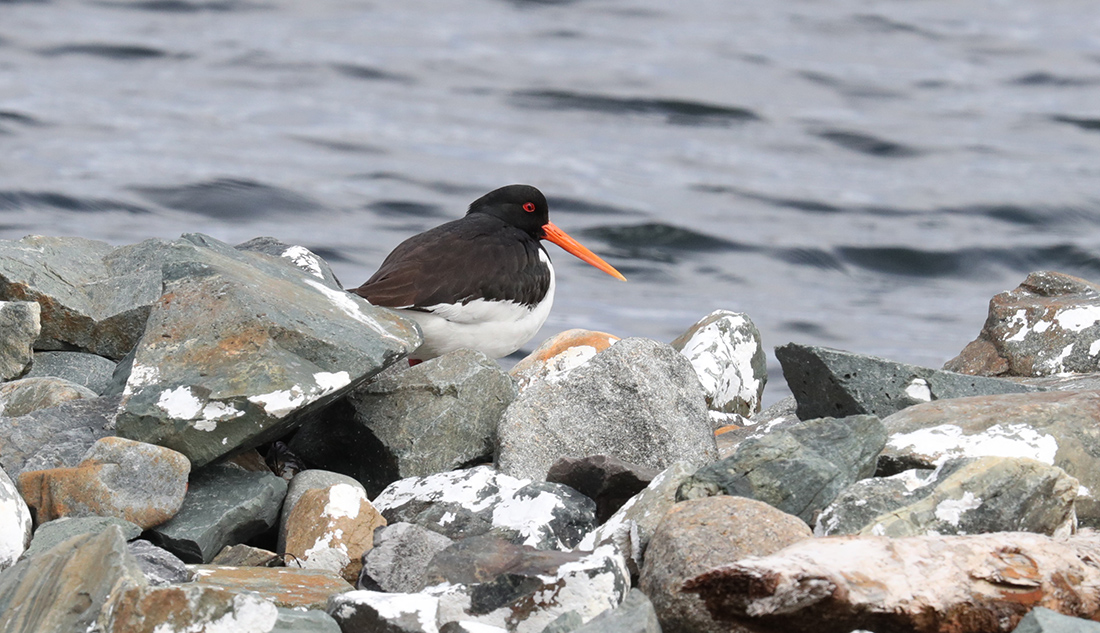
This picture alone is good enough to eliminate American Oystercatcher because it shows the blackish back nearly the same colour as the head. On male Eurasian Oystercatcher the back is nearly as black as the head. This one is thought to be a female based on brownish tinge to back and long bill (fide Anthony McGeehan)


The white wedge up the lower back is very different from the dark back of the American Oystercatcher. 


The huge white wing stripe is much stronger in the primaries then it is on American Oystercatcher.


There were still remnants of the winter pack ice in the area plus icebergs as seen from the ferry. 


There are three previous records of Eurasian Oystercatcher for Newfoundland and Canada.


1) Tors Cove, Avalon Peninsula, 22-25 May 1995,  
2) Eastport, Bonavista Bay, 3 April-2 May 1999,
3) St. John’s, Avalon Peninsula, 5 August 2006 


----------------------------------------------------------------------------------------------------------------------

AMERICAN OYSTERCATCHER COMPARISON


 American Oystercatcher late October 2016 in New Jersey


The American Oystercatcher is larger than the Eurasian Oystercatcher. The American also has a much browner back and lacks that ever so conspicuous white wedge up the lower back present on Eurasian.  The American Oystercatcher has less white in the primaries.  


d Ken Knowles. Right Side: Clyde,  Ethel Dempsey, Alison Mews and Ed Hayd

Friday, 12 April 2019

More Gyrfalcon Mania


Not easy following up on every Gyrfalcon sighting.  Usually it is too late to go look for a reported sighting by the time it is reported. You pretty well have to be within a couple of minutes away when one is sighted to have any hope of seeing it.  You can get your spirits down going out every chance you get to the prime Gyr sighting areas looking for your own sighting and coming up empty time after time.  Things changed for many people on 11 April when the Bay Bulls (Long Pond) killed a Herring Gull on the ice and stuck around most of the afternoon to eat it.  Thanks to Jim Walsh for keeping tabs on this bird over a  few days.  I could not handle the pressure sitting in an office knowing a white Gyrfalcon was presenting itself so nicely and bolted from work for an extra long lunch. Thing worked out. Below are some photo results.

A dirty well marked white Gyr. More of a Silver Gyr.  It is a Code 3 on the Mactavish Code of White Gyrfalcon Ratings. A Code 10 has an immaculate white head, body and tail with white comprising of more than 50% of the upper surface of the wings. The Cape Spear bird (see previous post) was a solid Code 9, nearly a 10 if it wasn't a for few flecks of dark on the side and back of head and flanks.


Did not know Gyrs were so agile and quick on their feet until I saw this one quickly walking toward its dinner on the ice that it had killed 20 minutes previously.

The air was clear without distortion allowing for big magnification and a major crop on this image.


THE GYR SCORE for the Avalon Peninsula in April 2019 (as of 10 pm 12 April)


1 - dark morph on 3 April at Witless Bay
2 - white morph on 3-11 at Cape Spear
3 - white morph on 6 April at Cape St. Mary's
4 - white morph on 6-11 April at Bay Bulls (Long Pond)
5 - white morph on 10 April at Cape Race road
6 - dark morph on 11 April at Portugal Cove South


Sightings of a white Gyr at Bowring Park, one on a building in downtown St. John's and two sightings at Quidi Vidi Lake may be the Cape Spear bird or possibly a different bird.

WHY IS THIS HAPPENING?

You can't google this question on the internet. Over the decades there has been a distinct pattern of an increase of of Gyrfalcons (and often Snowy Owl) in late winter 20 March - 10 April. It is not evident every year and it has been a good while since it has happened with Gyrfalcons. Disregarding this trend but probably connected I have this theory in a nutshell the current Gyr influx. Prolonged, very prolonged, cold far reaching NW winds along entire Labrador  coast and eastern Newfoundland through February and into early March helped more Gyrs drift into Newfoundland waters.   Gyrs  are perfectly at home living out on the pack ice during the winter and feeding on seabirds .  The Gyrs might have made their way back north mostly unnoticed except that in late March the ice off Newfoundland quickly disintegrated until there was nothing but a narrow strip of ice running off the tip of the northern Peninsula. This all happened quickly due to powerful westerlies beating up the ice etc.  So my theory says the Gyrs wintering at sea had to head to land in late March. Still winter in their minds the Gyrs didn't have to go back north yet. Once they hit the coast their search for food found some of them going farther south. The Avalon acts as a catch bag, the Cod End, they can't go farther south. But they are finding food here.  Lots of nesting kittiwakes coming back to the nesting colonies - prime meals for Gyrs. And Herring Gulls. The gyrs are getting Herring Gulls as well and they are abundant on the northeast Avalon at least.

This is my theory. In past decades when there has been this late winter Gyr influx the sightings stopped around 15 April. It doesn't feel like it is going to end that soon at this point. We will see what this weekend brings.  GYR ON!


Wednesday, 10 April 2019

Birding on a Diet of White Gyrs.

Early spring is a painful time in Newfoundland. A few robins, Fox Sparrows and Ring-billed Gulls arrive in early April. They sit around looking cold wishing that had not been in such a rush to get back to Newfoundland.  Sometimes if we are lucky there is something other than spring arrivals that keeps the birdwatcher ticking.  Over time (like decades worth) there has been a pattern of Snowy Owls and Gyrfalcons appearing on the Avalon Peninsula at the end of the winter - 20 March to 10 April is the magic time.  It is not an event every year. Most years it is not noticed at all. But in 2019 you could say were are having a little bit of a Gyr Storm in early April.  There have been four identifiable different Gyrfalcons on the Avalon in April so far.

1) 3 April - a chocolate bird photographed on a rock at point blank range by a hiker in Witless Bay.
2) 3-9+ April - a very white white morph seen most days but sporadically at Cape Spear.
3) 6 April - a white morph bird at Cape St. Mary's seen by Alison Mews, Ethel Dempsey and I.
4) 6 April - a white morph bird photographed eating a gull on Long Pond, Bay Bulls by Jim Walsh

It should be noted that each of these three white morph birds was photographed and are distinctly marked proving they are different birds.  Also during this time period Chris Brown had two sightings of a white Gyr chasing birds at Quidi Vidi Lake that may or may not be the Cape Spear bird.  And in the last half of March there was a white Gyr at QV Lake and another at Coley's Point, (near Bay Roberts).  These are probably different birds again.  

To me there is no doubt whatsoever that the White Gyrfalcon is the Best Bird in the World. (Sometimes I think otherwise when I am looking at Ivory Gulls.)  I've been looking for Gyrs every day when I could since this all started on 3 April. I got luck three times.  Below are photos from each encounter.

APRIL 3, 2019 - Cape Spear

This Gyrfalcon was riding the wind updrafts along the cliff at Cape Spear.

Every few minutes it would make a spectacular high speed flight far out over the ocean and disappear from sight.

It came back empty handed each time.


April 6, 2019 - Cape St. Mary's

A twenty minute look through the telescope on this bird  resting on a ledge below was INCREDIBLE.

The bird soared around the cliffs a couple time providing leisurely views.  It had bits of dried red meat on its bill indicating it had already fed this morning. 


At one point and far away from us an adult Peregrine Falcon came out of no where and was frantically dive bombing the white Gyr for two full minutes. A great show through the scope. The Gyr mostly shook it off but a few times retaliated.  Oh to have been over by that cliff edge with a camera while this was going on!


April 7, 2019 - Cape Spear (again)


A close pass. The best minute of 2019!


It ain't over until its over.  Probably won't go past 15 April but as I type I just got sent a photo of a white Gyr chasing pigeons at Bowring Park, St John's ten minutes ago and heard the Long Pond, Bay Bulls bird was photographed in a tree beside the road earlier this morning ..... Key-rist how is someone suppose to survive in an office atmosphere while all this is going on!!!!!!!!!!!!!!!!!!!!!!  

One white Gyr is never enough. The more you see the more you need that next fix.


Tuesday, 2 April 2019

Irish Birding in February - The Godwits

Both Bar-tailed Godwit and Black-tailed Godwit are common wintering birds in Ireland. In my experience 5-15 Feb 2019 Bar-tailed Godwit was more localized being found on hard sandy flats where they could be abundant.  Black-tailed Godwits were more numerous and widespread occurring on muddy tidal flats.  Sometimes there were a few Bar-tails among the Black-tails but did not see the reversal. Though there were places like Dublin harbour where vast numbers of each wintered but generally they flocked among their own species on their preferred substrate.

Bar-tailed Godwit is the rarer bird in Newfoundland. There is a record from Quidi Vidi Lake, St John's 26 October to 6 November 1973. And what was thought to be just one individual over three years at Stephenville Crossing 22-27 July 2004, 12-18 July 2005 and 5 June 2006. The Stephenville bird was thought to be baueri  the subspecies that breeds in Alaska. This is based on heavily barred underwings and barred rump. The Quidi Vidi Lake bird was not assigned to a subspecies but a vagrant from Europe lapponica would seem most likely. Like Common Greenshank and Eurasian Curlew, the Bar-tailed Godwit does not nest in Iceland but occurs there annually as a rarity in very small numbers. It will always be a big rarity in the province.

Bar-tailed Godwits were hard to get close to in Ireland though no doubt with a more effort ways could have been figured out to trick them into allowing close approach. 

 The pale edges to wing coverts and all the feathers on the upper surface of the bird are edged in pale creating a scaly appearance very unlike the the smooth gray of a winter plumage Black-tailed Godwit.

Winter plumage Bar-tailed Godwits are very clean well kept looking birds.


 Bill length varies considerably. Females have the longest bills.


Note the lightly barred underwings and rump characteristic of lapponica, 

The tail is barred!

Strong looking fliers, it is easy to see why they can pull of huge migrations.

The Black-tailed Godwit is a familiar bird to Newfoundland birdwatchers. Being a common breeder in Iceland it is a regular spring stray to province usually during the better European Golden Plover flights.  We see them in full breeding plumage, and the Iceland birds are the most intensely coloured of all the subspecies of Black-tailed Godwits across Eurasia. Most of the Icelandic Black-tailed Godwits winter in Ireland. For a godwit it is a surprisingly numerous bird in winter in Ireland.  Being so common place it was a bird that almost escaped action from the camera.

The gleaming white under wings and huge white wing stripe are conspicuous features of the Black-tailed Godwits in flight. 

During high tide it was not uncommon to find large flocks of sleeping Black-tails.

A bit pf preening during high tide relaxation time.

Full winter Black-tailed Godwit. A much smooth plumage than the winter Bar-tailed Godwit.

This one is showing some barring of breeding plumage.

Flashy underwings.

Sleeping in peace.

 A striking bird.