Wednesday, 5 February 2014

The Ice is Coming

This is the 5 February 2014 ice map for Newfoundland. The change since the 1 Feb is pretty significant. That is what happens during a period of cold weather accompanied by NW winds. The ice keeps on making and then moves on south smoothly with the Labrador Current.

What does this mean for St. John's based birders. In a word EIDERS.  The favourite wintering sites for tens of thousands of eiders on the east coast will be blocked with ice. The eiders will be forced to move south.  They might go to the south coast of Newfoundland but many stay on the Avalon. Places like Cape Spear can get be a eider bonanza.  There are several factors determining the level of eider watching at Cape Spear. Hunters in boats could prevent the eiders from feeling comfortable at Cape Spear. Did I say a couple of factors? Well hunters is the biggest factor even though they are quite rare at Cape Spear because it is too far for them to go in boat. The other big factor is the whim of the eiders. Luckily Cape Spear is hard to resist. Eiders love Cape Spear.  The visibility is good all-around and the feeding must be OK on the ocean floor.

In ice years eider flocks at Cape Spear can be massive numbering 5000+ at times. But they are very wary having been hunted all the way along the coast. These ones are all nervous about something.

This time it was just another birder coming along not realizing the eiders would flush if they saw a human form on the shore.  It is getting harder and harder to get intimate with winter flocks of eider at Cape Spear with so much activity on the weekends. For starters it requires getting down near the water and hiding among the rocks and waiting and waiting for your chance that may never happen.  It is a rare day when the weather Gods allow that to happen. 

A full adult drake King Eider is the prize for the Cape Spear weekender birding at Cape Spear.  This picture is the end result of several hours hiding in a crevice among the rocks on outer Cape Spear.  It was a rare day when the seas were relatively calm and the eiders came close and that this stonking drake King was there among the common eiders. 

Exceedingly rare - but how rare?- is the Pacific Eider (S. m. v-nigra), currently regarded as a race of Common Eider.  See the monster eider with the carrot-coloured bill in this picture? This bird photographed off Cape Spear in March 2005 is as far as I know the only concrete proof that this 'subspecies' from Alaska, Russia and western Canadian Arctic has occurred in Newfoundland and perhaps the Atlantic Ocean. At the time in 2005 I checked around and could get no solid evidence that it has reached the Atlantic. The research was short of exhaustive.  It does appear there are small numbers semi-regular in western Greenland in winter.  More research is needed. This Cape Spear bird is a perfect in every feature for Pacific Eider. 

Another picture of that Pacific Common Eider from 2005 showing details of the feathering around the bill that is finger-print fail proof evidence of this rare eider.


In a cold weather winter like this when the pack ice reaches the Avalon Peninsula the chances of encountering the ultimate ice birds are greatly increased.  Doesn't matter how many white Gyrs and Ivory Gulls you have seen the next one excites every cell in your blood stream and that is exactly what we need this weekend.  It could happen. 

Friday, 24 January 2014

The Snowy Owl Event - Supporting Proof of Our Worst Fears

Today Rene Pop of Texel, Netherlands sent me interesting information on Snowy Owls that relates directly to the fate of the Snowy Owls that took part in the huge influx on the Avalon Peninsula in late November/early December 2013.

We all wondered about the fate of these owls crowding the southeast corner of the Avalon Peninsula. The weekend of 7- 8 Dec was the peak of the wave as far as we could tell. 300 Snowy Owls were counted that weekend at Cape Pine and Cape Race.  We couldn't get out to these Capes after that time due to road conditions. It was not just food that was concentrating the owls at Cape Race. The barren rocky ground around the area is poor habitat for meadow vole.  Snowy Owls will eat small seabirds and we've seen the evidence found in past years at Cape Race, i.e. Dovekie parts in pellets.  But there was no way there were enough seabirds around Cape Race to support hundreds of Snowy Owls.

What ever happened to this Snowy Owl and numerous associates on the coastal barren along the Cape Race road after 8 Dec 2013?

We suspected the owls were on the run from food exhausted locations in the Arctic.We also suspected that since the birds, nearly all heavily barred (no white adult males noted) were inexperienced juveniles. We suspected Cape Race was a last resort land stop before taking your chances on going further south.  From Cape Race we saw a few owls coming in from the south and landing on the rocks with drooping wings.   Saw a group of three owls venture southward out over the ocean, one turned back, the other two kept on going.  Saw one or two others flying strongly high and southward.  

During that dramatic 300+ Snowy Owl weekend there was word of a number of Snowy Owls on the oil rigs 300 km east of Cape Race and various fishing boats at sea on the Grand Banks and off southern Newfoundland.  It just came to light today that a container ship travelling from NYC to Netherlands during the second week of December 2013 transported some Snowy Owls across the Atlantic.

The story is can be seen on site below and is translating from Dutch to English using Internet methods.  The crux of the story is: 9 Snowy Owls landed on the ship on 9 Dec when 50 miles south of Newfoundland. The ship looped southward toward the Azores to escape the storms.  The Snowy Owls on the boat was down to four birds when 50 miles off the coast of Spain on 12 Dec. Two birds were thought to have flown toward Spain. By 15 Dec as the ship approached the Netherlands the last two Snowy Owls flew off the boat.

The whole Story as translated from Dutch to English via computer is below.

On the web site address provided below there is a powerful picture of six desperate owls sitting together on a containers in the mid Atlantic.


"I'm on 15 november in Antwerp went on board as a passenger on the MSC Monterey, a container ship of 275 metres. The tour went to the East coast of America where we New York. After we had done the various ports to unload and load we left december 7, back towards Europe, Bremerhaven. The weather was already bad and soon throughout the trip we sat in a squall. On 9 december we carry about 50 miles of Newfoundland where we visit got from 9 snowy owls (2 males and 7 females). They appeared exhausted at the containers and then to sit close to each other, somewhat sheltered for the corresponding sea spray. Unfortunately we carry with a speed of 19 miles still further away from their habitat. The following days the weather was slightly better but the owls remained. So every now and then they flew shearing across the water looking for prey and then to land on the ship. Now no more close to each other, but when spread over the bow. 11 december, we come near the Azores and the temp. is 15 degrees plus. Not really a pleasant temperature for these owls and a heavy swell with 20 degrees of heel. You notice that they are impatient and hungry. december 12, we come close to Spain, it was the night, when the ship got rampage. The owls family, Right away 5 more, are still on board and the occasional flying there one or two a while brushed over the waves. The temp. today is 18 degrees and we swing Meanwhile 25 – 30 degrees, not enjoyable. december 14th, we sail along France (approx. 50 miles off the coast) and the family owls is getting smaller, hopefully they have reached the coast or have them chosen for another voorbijvarend ship. december 15th, we sail along Zeeland and the last owls leave the ship. I think the two were. These will certainly pick up the coast. So far my encounter with the snowy owls. "


Sunday, 19 January 2014

The Way I Like My Starlings


I prefer my starlings between the legs of a raptor. 

Especially if the raptor is an adult Peregrine Falcon.

Finger licking good right down to the last drumstick. This Peregrine Falcon has returned to a tree on the north side of Quidi Vidi Lake, St. John's, Newfoundland that it used daily for a couple weeks in February 2012.  It regularly brought starlings to this perch to eat.

"After I wipe my bill clean do you think there is a chance of an after dinner mint?"  The white mark on the left side burn is a unique mark identifying this individual. Sometimes adjacent feathers almost cover it up.  The mark was present last year also.

Some of you may prefer your starlings like this. 

This Peregrine Falcon was enjoyed by many at Quidi Vidi Lake today 19 Jan 2014.  It does not seem to mind people standing under it taking pictures. This is a rare opportunity to enjoy a wild Peregrine Falcon very well and close in Newfoundland.  


Saturday, 18 January 2014

Hanging Out Around the Lake

The complete turn around in the weather over the last two weeks has been remarkable. Two weeks ago who would have guessed someone would be canoeing in Quidi Vidi Lake this weekend. Quidi Vidi Lake is opening up at an alarming rate. We need the ice for resting gulls. The ducks are enjoying the spring weather and so are the people. I found myself in that same frame of mind for a couple hours at Quidi Vidi Lake on Saturday. I sat on a bench with the camera set up by the Virginia River mouth waiting for something to happen while enjoying the pleasant weather. The happenings were slow and subtle.

A sign of spring or at least the opening up of Quidi Vidi Lake is the appearance of Great Cormorants on the ice. It is only a late winter and early spring phenomena. They sometimes appear on other St. John's ponds but otherwise Great Cormorants are unheard on freshwater in Newfoundland. There were up to eight at one time present but through the comings and goings I figure a dozen or more used the lake while I was present.

This drake Wood Duck was a new arrival at Quidi Vidi Lake late this week. It is still learning the ropes on taking food handouts from people and prefers to hide up river when not doing that. Wonder where is was earlier this winter?


The St. John's winter population of 70+ Tufted Ducks were in a desperate position two weeks ago when the aeration system was turned off at Burton's Pond to conserve power during Blackout 2014.  They are laughing now, finding openings in the ponds around the city where they can feed like normal diving ducks, though they do not hesitate to accept food handouts. Eleven fed in front of me at Q V Lake along with a couple of Greater Scaup.

Finally after two hours of relaxing on the park bench there was a little payback in the form of a Peregrine Falcon. Actually I was hoping to see this bird since the species was missing on my winter list.  It flew directly to the roost tree used by the same bird last winter - a large poplar tree near the bandstand on north side of the lake. It totally tolerates people walking under it without them even knowing it is there.  The strong orange flush on the under parts and the odd little white mark on the left side burn confirms that this is the same bird as last winter.


Sunday, 12 January 2014

COMMON SNIPE Confirmed - Ferryland, Newfoundland

The suspicious yellow snipe found yesterday at Ferryland was well seen today 12 Jan 2014, albeit during driving rain.  It was decided it was Common Snipe based on the following...

a) underwing showing bright white axillaries with sharply contrasting relatively thin black bars, and flight shots showing pale underwings with white bars.
b) tertails with wide pale bars creating almost a marbled pattern (pale bars finer in Wilson's Snipe)
c) relatively light barring on flanks
d) the overall yellow colour while probably on the extreme side for Common Snipe is unlike the colder overall colours of the Wilson's Snipe

A few pictures now. A few more later.

Common Snipe

Wilson's Snipe on left, Common Snipe on right.

Common Snipe

Common Snipe on left, Wilson's Snipe on right.

Common Snipe

Saturday, 11 January 2014

Hot Snipe

Five photos of a possible Common Snipe from Ferryland, Newfoundland on 11 Jan 2014.  While more effective with comparison shots of Wilson's Snipe these quickies show the over all 'yellow' colour,  broad pale bars on tertials and relatively pale under wings.  Hopefully better photos and more information tomorrow.


Below are photos of the Tors Cove Common Snipe on 18 Feb 2011 being compared with Wilson's Snipe. Photos by Dave Brown. The Wilson's Snipe is the middle photo on the underwing composition and the right bird on the tertial comparison. 


Thursday, 9 January 2014

A Sculpin and Two Shags

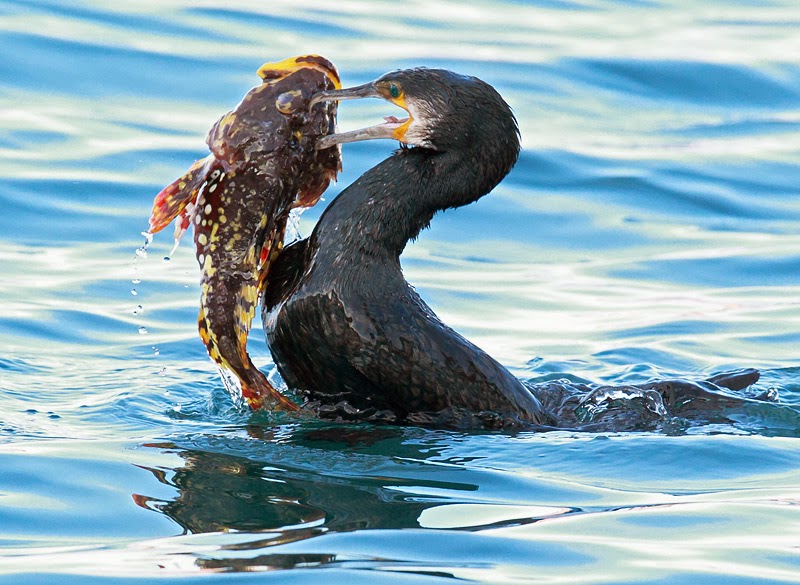
On 5 January 2014 I was parked on the South Side Road by the mouth of St. John's harbour. I was scanning for a Red-throated Loon that had gone on the missing list since a great west wind two days previous. Great Cormorants are a standard feature during the winter in St. John's harbour. I noticed one nearby was playing with a fish. A large fish.  I got the camera ready for the classic shot of a cormorant throwing its head back and letting a fish slide down its gullet. But the fish was a sculpin.  Cormorants are experts at swallowing sculpins down spines and all but this big? 

The adult Great Cormorant played with the fish for more than ten minutes.

The fish was more than it could handle.

The bright colours help identify the fish as a Four-horned Sculpin.


The fish would not go down side ways, right side up or upside down.

Then without warning an immature Great Cormorant popped upright underneath the adult with the fish. The fish changed hands so quickly it was not until I reviewed the photos that I realized the original cormorant had lost the fish. 
The young cormorant wasted no time getting the thorny fish down.  Did it hurt?