Thursday, 20 August 2015

White-winged (Black) Tern in Newfoundland - Day II

Day II of White-winged (Black) Tern in Newfoundland was quite similar to the pattern and timing of activities of Day One of Discovery.  Makes one wonder how long it has been here working this routine!!! Some are speculating that maybe it could be back in 2016 and we should start looking for it in June.

Photo buffs, which is pretty well everyone these days, are still agonizing for the ultimate shot. The bird is easy to see well with binoculars and a scope but is always a photo challenge. It is often just out of reach. The smooth plumage of the buoyant swift moving bird is hard for the AF systems to grab on to when the background is always beach rock, forest or houses. 

We are really getting to know this particular White-winged (Black) Tern and the species overall. A huge privilege in Newfoundland. It is an amazingly graceful striking looking bird. This is unanimous among the perhaps 30? people who have now gone to see the bird. A Black Tern is a gull in comparison to the fluid flighty movements of a White-winged (Black) Tern.

Here are a few snaps of the day....

Early in the morning it sat on the beach across the channel from the yacht club. 

During the morning relaxation period it was regularly flushed by crows or rowdy Common Terns.


When temperatures rose and insect life was mobile over Chamberlains Pond it was frequently present at that location. The pond is encompassed by residential housing.

.


Wednesday, 19 August 2015

WHITE-WINGED (BLACK) TERN - Yet Another Dream Answered

The coffee I bought on the way into work was left on the office desk unopened for four hours all because of a phone call.  At 09:10 Paul Linegar phoned all out of breath.  White-winged Black Tern at the Manuels yacht club he breathed.  His excitement was real but how could he be so certain since in the post breeding plumages of White-winged Tern are very similar to Black Tern which is also rare, not even of annual occurrence in Newfoundland? He said he was using an old Petersen guide he found on the boat he was on as he left the yacht club with a friend.  I asked a few questions about head details from what I could remember on the finer points required to clinch the identity of a fall White-winged Tern.  As the phone connection broke up he conceded that maybe he was not sure of the head details.

I didn't want to sound off a false alarm on a White-winged Term to the public domain so I phoned a Ken Knowles and a John Wells and told them about a tern, maybe a Black Tern but Paul thought it was White-winged Tern.  Twenty minutes later I was on the scene looking for a Black Tern.  Not much to see but a few Common Terns and gulls on the gravel bar.  Ken, John and Anne Hughes arrived. We looked around seeing nothing. Then a small group of tern flushed from way down the beach.  I saw one with a black body, so it seemed. Then it reared up and I saw the BLACK UNDER WING COVERTS. John saw it too. It was instantaneous euphoria that changed the rest of the day for every birder on the northeast Avalon.  Paul had forgotten to mention the bird was still in breeding plumage!  It was a stunning near full breeding plumage WHITE-WINGED TERN, First for Newfoundland.

The first responders to the scene of the WHITE-WINGED TERN getting their first looks in flight from the  Manuels yacht club.  

The WHITE-WINGED TERN left the yacht club flying directly over my head.  Note the patented black under wing coverts. They are whitish on a Black Tern. The white flecking around the head and neck show that it was starting to loose the breeding plumage. I am pretty sure the date is late for a North American  Black Tern to be in mostly breeding plumage. Wonder if it is an unusually late date for a WHITE-WINGED TERN in this plumage?

Eventually we figured out the WHITE-WINGED TERN was feeding just two minutes north of the yacht club at Chamberlain's Pond.  It would feed on flies on the surface of the pond for 10-30 minutes then head back to the gravel bar at the yacht club to rest and preen. The bird was still not close and the background of houses and trees distracted the AF systems on the cameras. Below are a few keepers out of hundreds of misses.  Even these are big crops. The photos are never good enough to satisfy a rare bird photographer. But hey, this bird is a keeper no matter the photo quality. Could have easily gone a life time without seeing a WHITE-WINGED TERN in Newfoundland.  It was a very beautiful bird with the rarity status and overall sum of quality approaching the value of the April 2014 Ross's Gull at Torbay. Maybe tomorrow for the million in one photo.


Monday, 17 August 2015

A Couple of Late Summer Nesting Details

On 8 August 2015 as John Wells, Ken Knowles and I were cruising through the community of St. Mary's checking out the usual birding points and were surprised to see three Barn Swallows flying overhead on Road X.  August is a poor month for Barn Swallow records. Most Newfoundland records occur during the spring and fall migration periods, May-June and Sept-Oct. We carried on with our day.  A weekend later on 16 Aug I found myself on the same Road X in St. Mary's with those swallows still flying overhead. Lingering Barn Swallows in August rang every alarm bell. There were now five Barn Swallows, three with full adult long tails and two with short tails like one-year old or perhaps juveniles. Against the bright white sky it was difficult to see details of the plumage. Impatiently I walked over to the closest building which as it turned out was not being used and BINGO there was a Barn Swallow nest over the door light shade. There were the arses of two nearly fledged young pointing in my direction.  I didn't want to cause a premature flush of the young birds so hung back.  I got the camera out of the car and got theses snaps.

The arses of two not yet fledged Barn Swallows on a nest at St. Mary's is quite a rare sighting in the province of Newfoundland and Labrador. 16 August 2015

The large deposit of droppings beneath the nest perhaps indicates more than two young were involved.  The two short-tailed Barn Swallows flying with the three adults over the nest site were possibly just fledged flying young from this nest. 16 August 2015
_________________________________________________________________________________

On a family outing aboard one of the Witless Bay Ecological Reserves tour boats on 15 August I noted an encouraging abundance of nearly fledged kittiwakes on the cliffs.  Hopefully the parent birds were still able to find a food supply good enough to finish off the rearing of the young even after the spawning capelin moved offshore.

Lots of nearly fledged kittiwakes sat on the nests at Gull Island. Witless Bay Ecological Reserve on the latish date of 15 August.

There were plenty of Common Murres standing around doing 'nothing'.  

I could hear the familiar cries of young murres from within this mass of murres on Gull Island but could not see any of the fluff balls.  Seems late in the summer for this many murres to still be massed on the breeding site. Not sure if there is a significance to this or if it is my ignorance of the breeding chronology of Gull Island Common Murres.  


Sunday, 19 July 2015

Emergency Golden Plover Posting - re CSM Plover

A hasty post after word reach the masses this afternoon about a golden plover in high breeding plumage seen at Cape St. Mary's, Avalon Peninsula, Newfoundland on 16 July 2015 by a tour group lead by David Trently. A day or two later a Cape St. Mary's guide (Kyran) got the photos below of the bird. These photo surfaced today.

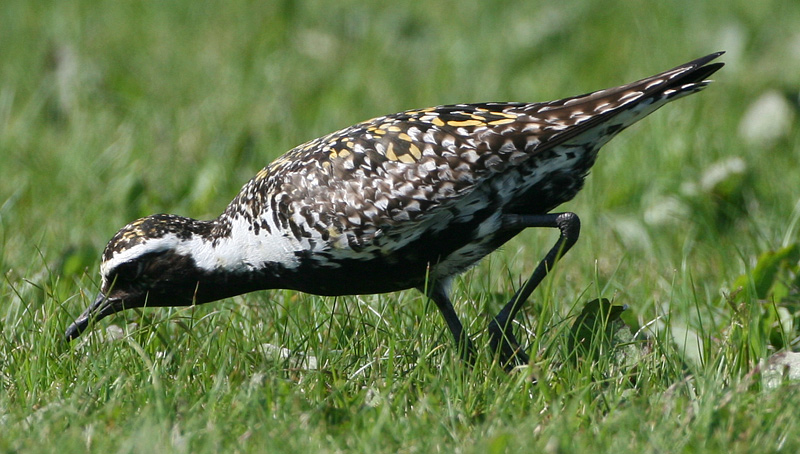
The white line running from neck and along flanks to undertail is a sign of Pacific and European Golden Plover.  The hint of fairly dark undertail coverts and suggestions of dark flecking in the white flanking are indications of Pacific Golden Plover.  There have been no records of European Golden Plover during July in Newfoundland but two for Pacific Golden Plover (July 2007 and July 2011)

Separating PGPL from EUGP is a lot easier when you see them in life and get a feel for the slimmer more American GP like actions of the Pacific GP.  European Golden Plovers are dumpier slightly less dainty birds.  Excellent photos of the Cape St. Mary's bird might show more details of the undertail coverts and flanks. Brown under wing coverts would eliminate EUGP.

I am on a ship and duty calls in ten minutes. Internet is sporadic and slow. I will post some photos of Newfoundland Pacific and European Golden Plovers now and hopefully later tonight add some captions.

EUROPEAN GOLDEN PLOVERS

(spring 2014 Avalon Peninsula)


----------------------------------------

Pacific Golden Plover
(July 15, 2007 - Trepassey, Avalon Pen, NF)


--------------------------


Pacific Golden Plover
(June 5, 2010 - Cape Race, Avalon Pen, NF)


Thursday, 16 July 2015

Rare Birds of North America - The Book

When jailed on a seismic vessel on the Grand Banks for the foggy month of July you have a lot of time to read.  This month I’ve been digging into the new book Rare Birds of North America by Howell, Lewington & Russell (Princeton University Press, 2014).  The book is a collection of accounts of North American rarities occurring < 5 times per year since 1950.  The species accounts (262 species covered) list or summarise the North American occurrences depending on the number of records. The records are analyzed for seasonal and spatial patterns with explanations offered for why they exist and what to expect in the future.  Each species account includes a fully detailed section on identification including illustrations by Ian Lewington. The lavish illustrations are beautiful to look at besides being accurate and informative.  All the plumages likely to be encountered in North America are included. 

The 40 page introduction to the book describes current thoughts and brings to light less well known ideas on bird vagrancy to North America.  Clearly written and easy to understand facts and ideas are explained and backed up with visual aids in the form of global maps making it easier to picture how birds might travel from one continent to the next. Even the use of the word vagrancy is discussed.  It is great to have all these ideas, some having been tossed around over the years, all in one place. The book is a definitely a keeper for hard core vagrant hunters but also useful for average intensity birders.  For instance I found the book useful this spring for looking up the North American occurrences of Little Egret and Garganey. It summarizes the records of these relatively regular vagrant species and gives explanations with the best evidence available, on the likely routes of their journey from the other side of the Atlantic to North America and eventually to Newfoundland.  It makes sense out the strong west, not east, winds that immediately preceded the sighting of both birds.

While the book does not deal directly with why we find southern warblers in the Avalon alders in September, you can build your own ideas by reading about drift migrants.  How migrating birds that find themselves over a large body of water and getting low fuel reserves on board may take the most energy efficient route to safety which is flying with the wind. Little did they know how far away Newfoundland was when they made that move! But in nutshell this is why we Avaloners yearn for SW winds during September and October hoping for those strays originating from the eastern US.

Pacific Golden Plover (PGPL) is not covered by the book because it breeds in Alaska.  There are only a handful of records for eastern North America. Newfoundland has three records:

  •      27-28 June & 9-15 July 2007 (Trepassey)
  •       6-8 June 2010 (Cape Race)
  •          30 July-3 August 2011 (Bellevue Beach)


Using theories outlined in this book one can form a picture of how PGPL could have happened in Newfoundland.  There is the mirror-image migration theory. A misorientation where birds leaving breeding grounds in Alaska and intending to fly southwest for a long distance to reach wintering grounds in the western Pacific and Australia actually fly southeastward for an equally long distance. SE is the mirror-image of SW.  The course changed but the programmed distance was similar.  This simplified theory is a plausible explanation for the Trepassey and Bellevue records which occurred during ‘fall’ migration.  But how do we explain the spring PGPL record from Cape Race.  Possibly it was a bird (even the same bird as Trepassey three years earlier!?) that had migrated south on a mirror-image misorientation and ended up wintering in eastern North America and in spring was retracing steps back to Alaskan breeding grounds. 

Considering the huge rarity factor of PGPL in eastern North America it is conceivable that the three Newfoundland records involve just one bird, though the Bellevue bird appeared to be a female and the Trepassey and Cape Race birds looked like males.  The three records fall within a five year period and are all on the Avalon Peninsula.  Time will tell if a pattern of July records materializes. 

There is another example of an Alaska-type shorebird reaching Newfoundland in July and then appearing in the following spring. The Bar-tailed Godwit at Stephenville Crossing in July 2005 had barred underwings coverts marking it as baueri the race breeding in Alaska and Siberia.  The following spring on 5 June a Bar-tailed Godwit appeared at Stephenville Crossing. The underwings were not observed but bird looked the same and considering how rare it is in Newfoundland there was a high probability it was the same bird retracing its mirror-image misorientated fall migration route from the year before. 


A vague pattern is developing. Newfoundland can get long distant migrant Alaskan breeding shorebirds.  Another long distant migrant shorebird nesting in Alaska with a similar migration route to PGPL and baueri Bar-tailed Godwit is Rufous-necked Stint.  There already is a light pattern of July occurrences in the northeastern United States.  In July Rufous-necked Stints are still in breeding colours, not to be confused with Sanderlings retaining breeding orange around the face and breast in July.  A Rufous-necked Stint is a bird to be aware of when shorebirding in July.  July is NOW!

Pacific Golden Plover at Trepassey, Avalon Peninsula, Newfoundland on 27 June 2007

Pacific Golden Plover at Cape Race, Avalon Peninsula, Newfoundland on 7 June 2010 sheltering out of lashing wind and rain outside drivers car window. Same bird as Trepassey bird three years earlier???

Bar-tailed Godwit at Stephenville Crossing, western Newfoundland 13 July 2005.  The barred underwings are characteristic of the subspecies baueri which breeds in western Alaska and northern Russia.

Bar-tailed Godwit at Stephenville Crossing on 5 June 2006. Same bird as present the July 2007?? Perhaps retracing its southward migration back to Alaska?

Thursday, 2 July 2015

Odds & Ends 27 June 2015

On Saturday 27 June 2015 visiting Mike Force (BC) and I did the Southern Avalon Loop. It could have easily been a mundane early summer trip but a little luck and taking our time turned it into a nice day of birding. Mike made stars out of common summer trash seeing things like his first breeding plumage Blackpoll Warblers in years and there were other eastern birds so common for us that I can't even remember what they were now.  

The calm overcast and cool weather made for excellent conditions of scanning over the barrens. The high vole population has brought in some nice summer mousers. We saw three Short-eared Owls, one Snowy Owl, a pair of Rough-legged Hawks and three Northern Harriers. Short-eared Owls have begun appearing everywhere starting in June. Where were they in April and May? How did they find out about the voles? No pictures of the owls this time.

I was happy Mike didn't mind taking time to photograph a pair of tame Horned Larks feeding on the side of the Cape Pine road. He was taking pictures too. There was hardly any yellow on their throats. Had they faded since spring? I am not really sure what our breeding Horned Larks should be like but in April the throats are brighter yellow but maybe those were migrates heading farther north.

The male of the pair of Horned Larks sported a nice rack of horns.


There was very little yellow in the face.  Was it yellower in spring when it arrived three months ago?  Did the southern Avalon winds blow the yellow away leaving a wind-blown washed out white face?.

----------------------------------


The female had a speckled forecrown and less intense facial markings.

When trying to touch up the sharpening around the head of the female lark I accidentally used the cloning tool. Suddenly I had a second head and in a matter of seconds there was an identical twin female Horned Lark sneaking in the side of the picture.  
----------------------------------


This is a bright yellow Horned Lark photographed at Cape St. Mary's in mid April 2014. It was very tame by the parking lot so thought to be one of the tourist-hardened Horned Larks that nest there.


-----------------------------------------

While spending time with the Horned Lark we had one eye in the sky waiting for one of the Rough-legged Hawk pair known to be in the area to turn up. It happened. Didn't take long for it to catch a vole and head off to coast where it likely has a nest of chicks which by the way is the most southerly nest of Rough-legged Hawk in the world. They have nested here before. If you look close you can see the tail and one hind leg of the vole.


The most unusual sighting of the day was this duck.  A small bachelor group of teal at the community of St. Mary's held a Common Teal.  I've seen lone drakes in late May on the Avalon that likely inseminated a local teal but this was the first in June that I am aware of for Newfoundland.  So far hybrid Green-winged X Common Teal are quite rare. I have seen just three over time in Newfoundland but two of those were at Lundrigans Marsh in St. John's during June 2015.  


Tuesday, 23 June 2015

A Late June Glossy Ibis - Odd Date for this Rarity.

June 23 is a late date for a spring overshoot Glossy Ibis in Newfoundland.  But there was one (maybe two) in the St. John's area today. The first sighting of a Glossy Ibis was in the morning at Lundrigans Marsh at the eastern end of St. John's.  Then in late afternoon news surfaced of a Glossy Ibis at the unlikely location of the Ruby Line Duck Pond in The Goulds (<ten minutes as the ibis flies).  We don't know exactly when this bird appeared so can not be sure if there were two Glossy Ibis today or one.  Or if there is a connection with the two Glossy Ibis at Third Pond in the Goulds for one day only on 25 May?

The Goulds bird today was feeding ravenously and was exploring some wet places that seemed marginal for a Glossy Ibis.  It was acting like it was a new bird on the block having just arrived in Newfoundland or the area at least.  Maybe some other southern vagrants will surface in the next day or two that would support the idea of a fresh arrival from the south.  Today we experienced the remnants of named tropical storm Bill. But that was such a low key slow mover it seems unlikely to be the force behind Glossy Ibis in eastern Newfoundland.

The Glossy Ibis at the Ruby Line Duck Pond, Goulds, Avalon Peninsula, Newfoundland - 23 June 2015.

Who knows how much it was finding to eat.  It hardly stopped probing deep into the mud and water long enough for a breath.  

It was a bad hair day at times.

Who is the ugly duckling here?

This is a photo of a White-faced Ibis from  southern Alberta in June 2009 where it is a locally common nester. The wide white border around the red lores (not gray) and the pink legs (not gray) and red eye (not dark) tell the story. White-faced Ibis has been expanding eastward in leaps and bounds and is likely to happen in Newfoundland in the near future.